The Breath of the Press: Padua 1604, Between Science and Flavor
The Birth of Bigoli: From Manual Craft to the Dawn of Modern Mass Production
In the Padua of 1604, genius did not reside solely in abstract calculations; it flowed through the hands of carpenters and pasta makers. Imagine the scene: outside the windows of Palazzo Moroni, the city is buzzing with a new energy. Galileo Galilei, in the heart of his Paduan years, is teaching the world that the universe is written in the language of mathematics. But just steps away, in a workshop thick with steam, another fundamental page of human history is being written—not with ink, but with dough.
The Machine of Abundance
Until that 26th of January, pasta was an individual act of love: a woman rolling out dough, a fragile and limited gesture. The document recently discovered in the State Archives reveals the exact moment when Bigoli became a product for the people.
This is where Galilean mechanics come into play. The press (the legendary bigolaro) is a magnificent application of physical force: a worm screw that, turning slowly and inexorably, transforms human effort into hydraulic pressure. Galileo would have smiled to see how that device multiplied the power of the arm, allowing it to tame an incredibly tough dough that would be impossible to work by hand.
Friction: Where Physics Becomes Flavor
There is an invisible poetry in the encounter between the dough and the bronze of the die. As the screw presses down, the pasta “struggles” against the walls of the hole. This friction, which Galileo studied in his experiments on motion, is what gives the Bigolo its soul: that rough, almost scratched surface, perfectly designed to grip the sauce.
While the scientist observed the moons of Jupiter, the people of Padua were discovering that mechanics could create a pasta capable of holding seasoning like no other. It was no longer just food; it was a masterpiece of gastronomic engineering.
A Ritual Connecting the Centuries
There is something deeply romantic about that 1604 manuscript. It tells us that modernity was not only born in laboratories but also amidst the aromas of bread and pasta. Bigoli are the children of that Padua: tenacious like the character of its people, rugged like the Venetian land, yet perfect in their scientific conception.
Eating a plate of bigoli today means tasting a piece of that revolution. It means feeling the resistance of a dough conquered by the strength of a 17th-century machine; it is tasting the intuition of an e7ra that decided to feed the many, not just the few, through the power of ingenuity.
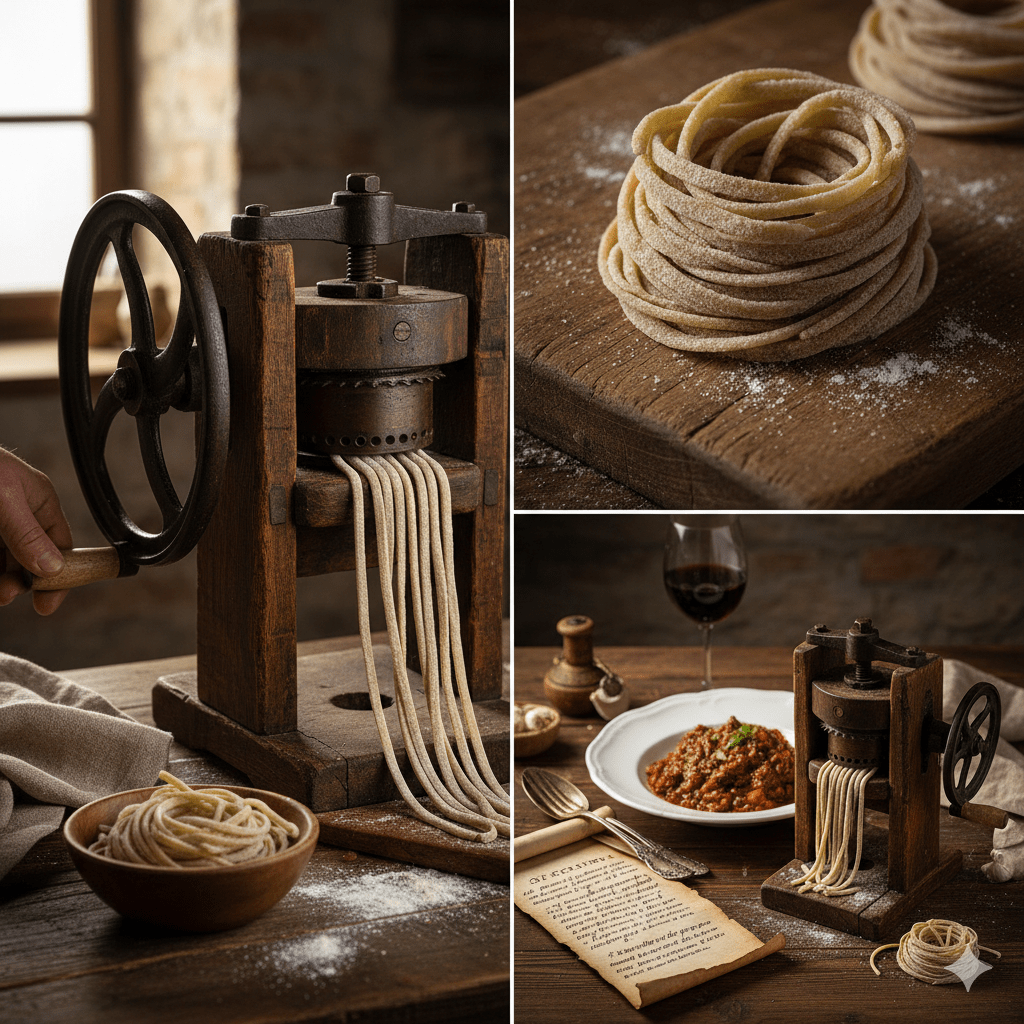
📜 De Origine Bigolorum – Patavii MDCIV
In the name of Ingenuity and Taste,
Let eternal memory be made that on this day, the 26th of January in the Year of our Lord 1604, in the noble and sublime city of Padua, crossroads of stars and wisdom, order was given to matter so that it might bend to the power of the Machine.
While the illustrious Master Galileo Galilei interrogates the firmament with his lenses, revealing the laws of motion and the lever, here, in the heart of the Paduan land, the same science descends among mortals to nourish the body.
By means of a Press of bronze and wood, with an infinite screw and constant pressure, the miracle of transformation has been achieved: flour and water, no longer stretched by weak hands, but driven by the genius of Mechanics, become Bigoli.
Let them be:
- Tenacious, as the logic of mathematics;
- Rugged, to hold the essence of the seasoning, just as the scholar holds the truth;
- For all, so that technology may not be the boast of the few, but the bread of the people.
From the archival papers to the table, from calculation to flavor, let the glory of Padua remain steadfast: where Science became food, and the Bigolo became history.
 Study Italian in Italy