
An international research team led by the University of Padua is investigating for the first time with a scientific method the origins of stuffed pasta, one of the most iconic dishes on the Italian table.
Using a scientific method to reconstruct the origins and evolution of the great variety of stuffed pasta present in our country, one example, among many, of Italian biocultural diversity.
To create the dataset, the authors relied both on scientific literature on the topic and on some foundational texts of Italian cuisine, such as the legendary volume by Pellegrino Artusi “Science in cooking and the art of eating well” (1891) .
A separation was made between the Eurasian filled pasta formats (such as gyoza, maultaschen, pierogi, pelmeni…), grouped as out-groups and used as an element of comparison, and the specifically Italian ones.
There are 28 formats selected, and include a variety representative of the entire national territory, from Sardinian culurgiones to Friulian cjarsons, from Bolognese tortellini to Romagna cappelletti.
By analyzing the various characteristics of this pasta “family” (dough ingredients, type of filling, cooking method, size, folding, etc.) and the geographical distribution of the recipes, the researchers have developed a phylogenetic tree that reconstructs the probable origin and diffusion of stuffed pasta in Italy, as well as its progressive differentiation into different regional and local forms.
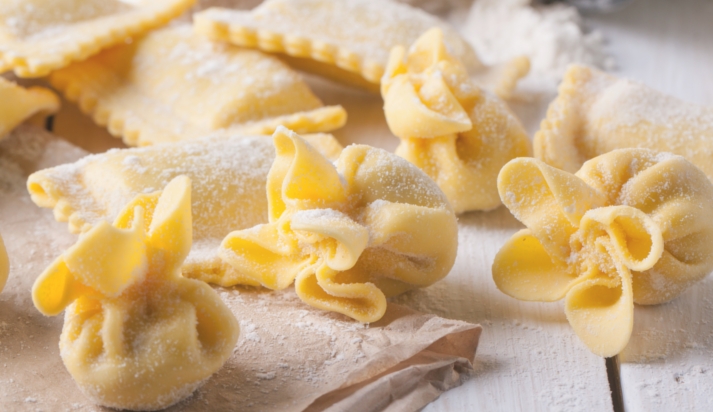
The results of the analysis show that it is very likely that stuffed pasta, which originated in Eurasia, first arrived in Northern Italy, and from there spread to the rest of the Peninsula following an initial reduction in morphological variability (outside the biological metaphor , the variety of recipes) due to a sort of “founder effect”.
The phylogenetic tree also allows us to reconstruct the relationships between the different forms of stuffed pasta.
A main distinction is evident between two large “families”, that of tortellini (more three-dimensional) and that of ravioli (flatter). Both groups appear to originate from northern Italy, where in fact most of the formats taken into consideration for the analysis are concentrated.
«In Italy, pasta is, like every ingredient, product and dish in gastronomy, an ethno-ecological web in constant evolution and where ecological and socio-cultural connections have always converged. This work adopts a method well known to biology, and applies it to the evolution of the “stuffed pasta” food system. It was a pioneering path that we imagine could be applied to other culinary trajectories and be a harbinger of surprises not visible based on historical investigation alone.
Your experience:
- https://www.studyitalian.it/cooking.html
- ttps://studyitalian.it/wine.html
- https://www.studyitalian.it/italian-fwc.html
italianfood #italianstyle #italianculture #italiancuisine #italianwine #foodlover #foodvalley #bologna #napoli #salerno
EXPERIENCE THE DIFFERENCE
TASTE THE BEST
 Study Italian in Italy