

Today we are talking about a succulent first course, or main course, from our main island: Sicily. The Timbale of anelletti, a particular durum wheat semolina pasta in the shape of a small ring ...

The seasoning may vary from area to area, but it is still a rich and tasty preparation, and for this reason it is normally consumed on Sundays or at house parties. Start by cooking the pasta very "al dente"; at the same time the molds are buttered and breaded and the sauce is cooked.

The base is always a meat ragu (perhaps loin or sausage), based on sautéed celery, carrot, onion and fresh tomato. Together with the red ragù, mix peas, diced cooked ham, fried aubergines (as in the famous Norma), caciocavallo cheese (or mozzarella if you want it lighter), and possibly a hard-boiled egg.

The drained pasta is seasoned in this way and the molds are filled, pressing lightly with the back of a spoon. Finally, sprinkle with grated Parmesan. In the oven at 180° for at least 25/30 minutes; remove from the oven, leave to cool and invert onto a serving plate
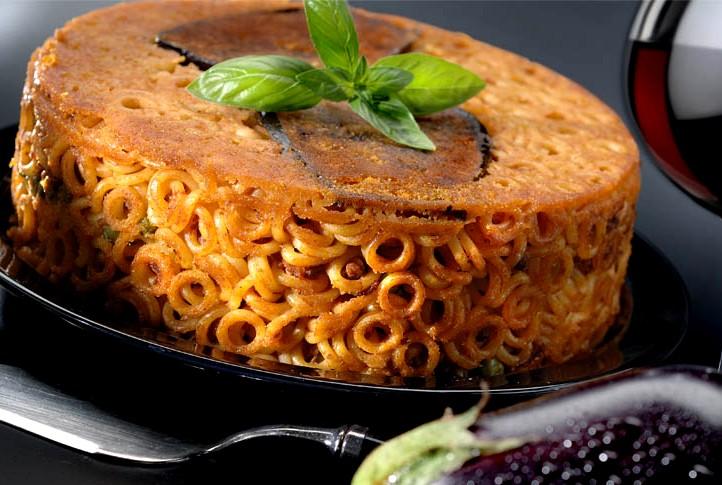
Oggi parliamo di un succulento primo piatto, o piatto unico, della nostra isola maggiore: la Sicilia. Il Timballo di anelletti, un particolare pasta di semola di grano duro a forma di piccolo anello …
Il condimento può variare di zona in zona, ma è comunque una preparazione ricca e sostanziosa, e per questo viene consumato normalmente la domenica o nelle feste di casa. Si parte cuocendo molto al dente la pasta; nel contempo si imburrano e impanano gli stampi, e si cuoce il sugo.
La base è sempre un ragu di carne (magari lonza o salsiccia), su base di soffritto di sedano carota e cipolla e pomodoro fresco. Insieme al ragù rosso si mescolano piselli, dadini di prosciutto cotto, melenzane fritte (come nella celebre Norma), cacio cavallo (o mozzarella se si vuole più leggero), ed eventualmente uovo sodo. Si condisce così la pasta scolata e si riempiono gli stampi, schiacciando leggermente con il dorso di un cucchiaio. Si spolvera infine con Parmigiano grattugiato. In forno a 180° per almeno 25/30 minute; sfornare, lasciare intiepidire e capovolgere nel piatto di portata
 Study Italian in Italy